
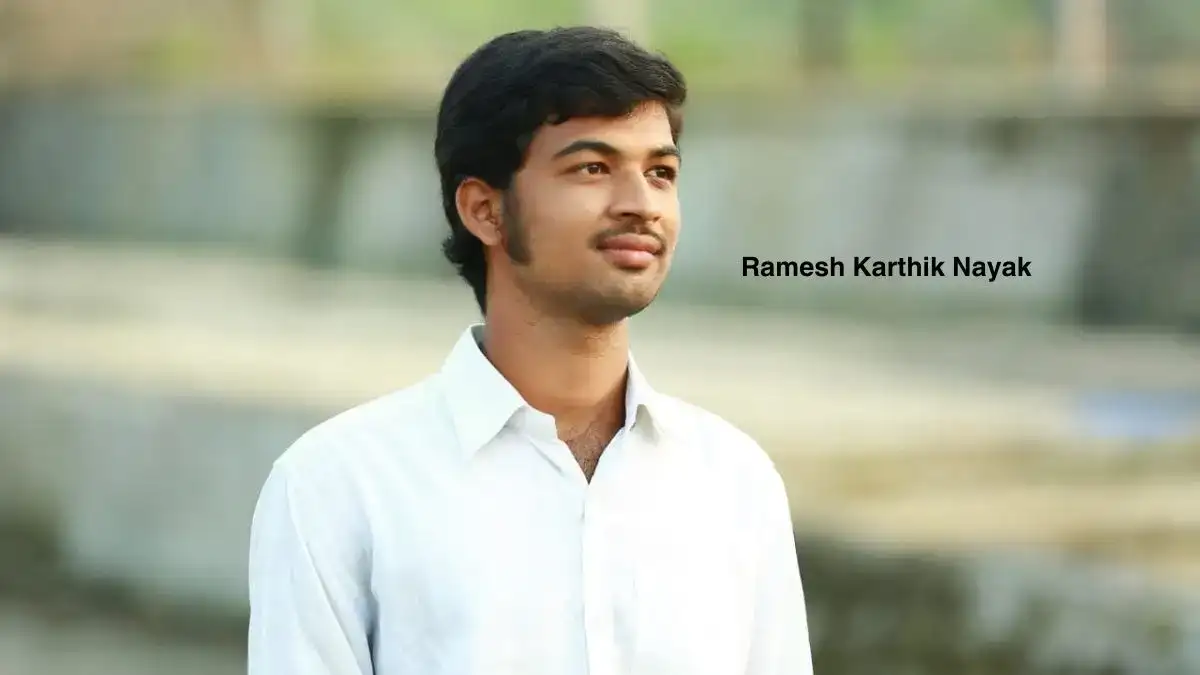
We got a chance to have a candid conversation with Ramesh Karthik Nayak, the multiple award-winning author.
Ramesh Karthik Nayak (b 1997) is a Banjara (nomadic aboriginal community in South Asia) writer from India. He writes in the Banjara dialect through the Telugu script and in Telugu and English. He is one of the first writers to depict the lifestyle of the Banjara tribe in literature.

1. How have the values, traditions, and oral histories of your Banjara(tribal) community influenced and shaped your poetry and prose, and could you share specific experiences or stories from your community that have significantly impacted your writing?
I cannot be sure that my background influenced my writing in my early times while I was urging to write or dreaming of becoming a poet/writer. But later on, The language, songs, beliefs, festivals, and colorful attire deeply influenced me and drew a fence around me, to record its contemporary history. And meanwhile, I was searching about my tribe in Telugu literature. But I did not find any. There are a few stories written by outsiders. I have come across a few nonfiction books by Insiders Dr. Dhananjay Nayak, Bhangya Bhukya, and Prof Surya Dhananjay. Not a single fiction book was found. Then I found a purpose that I should write something that I know. And this void should be filled by me. And it’s in 2016 I think Mahasweta Devi passed away. At that time I had decided to write about myself and my people.

2. Can you give our readers some insights about your books published till now? Few lines about each book.
Telugu Books
- Balder Bandi: Ox- cart(2018) Poetry collection.
- Dhaavlo: The song of Lament(2021) Short story collection.
- Kesula: Flames of forest(2022) Compilation of Banjara short stories. Compiled along with Prof Surya Dhananjay.
English Books
- CHAKMAK: Flintstones(2023) Poetry Collection. Published by Red River Press.

3. For whom do you write, and what impact do you envision your work having, both within your tribal community and for readers from diverse cultural backgrounds?

I write everything, every line about my people. Rather it might be an impact, but the Truth is that there are many rumors spread across the country about our people. It might be about our habitation, about our attire, about the reservation that we have for our education or jobs, etc. When it comes to the literature that I’m trying to create will definitely show the true life of my people, who are the guest characters in movies or books, that too as a thief, murderers, etc and women are meant to have item songs or adulterous characters. So when we tell something about a community in literature, the names, conversations, beliefs, and everything will drag us into a broad canvas of cultural backgrounds. The impact will be based on the reader’s mood and how much percent of respect he/ she has for the community.

4. What role does your writing play in preserving and promoting your Banjara (tribal) culture and languages?
For now, we cannot immediately decide the role of our writing because, still there are some infinite nomadic communities who don’t even know what they are. In this 21st century, we the people started understanding our color, scriptless language, oral traditions, attire, and customs by the unseen discrimination that the world shows in the form of mercy. That mercy when it passes to a second person in the form of a word or phrase is turning into an anger and self-proclamation of oneself towards a certain downtrodden community creating a new Postmodern discrimination.

5. What notable challenges have you faced, and what are some of your most significant achievements or moments in your writing journey?
Firstly I was dubious that no one was going to read my words. And as I published my poetry collection with many helping hands. Immediately the response from readers made me believe in my own writing. And my achievements are:
- Awarded Tribal Young Achiever Award for contribution to tribal Literature(Telugu), Telangana State Tribal Welfare Department, 9 August 2021.
- One of my poems is taught as part of the Telugu literature curriculum at SR&BGNR GOVT DEGREE COLLEGE, TELANGANA STATE.
- Blader Bandi, Collection of poems taught as part of the MA- Telugu literature curriculum(2nd Year) at ANDHRA UNIVERSITY, Visakhapatnam.

- Balder Bandi, poetry collection – 2018
(Twice shortlisted for Kendra Sahitya academy Yuva puraskar – 2021 and 2023.)
- Dhaavlo, short story collection – 2021
(Twice shortlisted Kendra Sahitya Akademi Yuva puraskar – 2022 and 2023.)
- Chilakamarthi Lakshmi Narasimha puraskar – 2018, Hyderabad.
- Telangana State Literary Award, 2018 – Bodhan.
- Nava svaranjali puraskar, 2019- Muvva Rangaiah Foundation. Khammam.
- Banjara Youth Icon Award, 2021- Warangal.
- Raavi Sasthri Kadha Puraskaram, July 2023- Udayini, Visakhapatnam.

6. Can you list your favorite authors, writers, and poets across the languages and why you like them?
- Telugu: Raavi Sasthri. His writing shows the extremity of life.
- Punjabi: Amrita Pritam: Her poems teach us about love and pain.
- Spanish: Gabriel Garcia Marquez: His characters drag us into a utopia, where we search for ourselves. And the confusion his plot erupts in us is something. That helps us develop our style.

7. Your latest English poetry book, Chakmak, got positive and inspiring reviews. From an outsider’s point of view, what do you say about the book? Why should people read it?
There are millions of stories, poems, and essays. Definitely, something somewhere already had been interpreted. We are interpreting something again, squeezing it from our daily life, that’s the reason it seems a little unfamiliar to our metropolitan life. So outsiders or insiders need to be in the mood to read or have a little sympathy about books. I must insist people read my book because it was written by me. It might be funny to you when you listen to my words.
8. How do you envision the future of tribal literature and languages in a globalized world?
I’m hoping to have indigenous literature in each and every language. Not for the sake that there is no recorded history or other things. But it is important to know something unique and strange to believe, how can a person survive without water, food, or science medicine? How the things are stored for decades together without any pesticides. Beliefs and skills etc. Aboriginal peoples are the different and unique groups we have.

9. Presently what are you doing and on what topic you are working on?
Presently I’m a lecturer at a Junior College, where I teach English and also conduct interviews with Telugu Writers on the Doordarshan(Yadagiri) channel. Presently I’m editing a Compilation of Telangana Banjara short stories along with Prof Surya Dhananjay, Dr. Dhananjay Nayak, and Mantri Srinivas.








 is a Banjara (nomadic aboriginal community in South Asia) writer from India. He writes in the Banjara dialect through the Telugu script and in Telugu and English.)