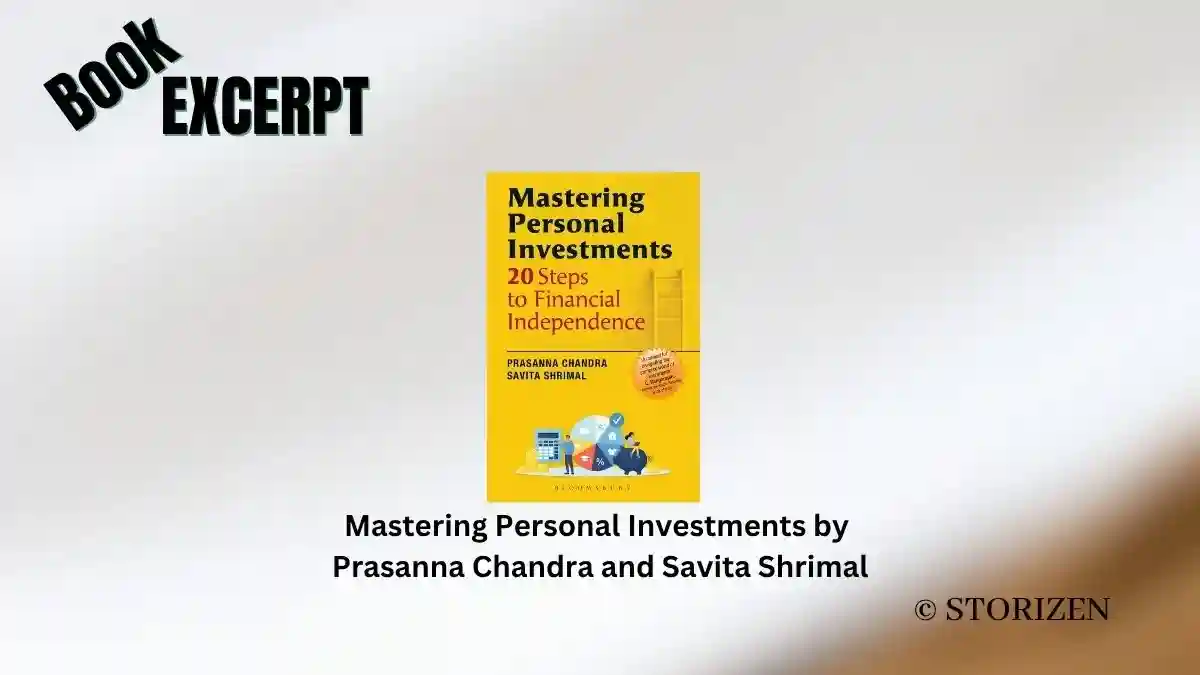
Book Title: Mastering Personal Investments: 20 Steps to Financial Independence
Author: Prasanna Chandra and Savita Shrimal
Publisher: Bloomsbury India
Number of Pages: 300
ISBN: 978-9361316418
Date Published: Jun. 17, 2025
Price: INR 382
Book Excerpt
Take Charge of Your Investments
Investing is a lifelong journey, and you are the captain of the ship
Pg. 1 to 4
Many People Consider Investing to be a daunting activity. They are bewildered by the profusion and proliferation of investment alternatives, rattled by fluctuations in financial prices, overwhelmed by the presence of mighty institutional investors, confounded by exotic instruments and complicated investment strategies, confused by the intricacies of the tax system, and exasperated by the financial scams that periodically rock the market.
Notwithstanding these concerns, investing can be a fairly manageable, rewarding, and enjoyable experience if you adhere to certain principles and guidelines. This book is based on the premise that an intelligent lay investor does not suffer any handicap vis-àvis sophisticated professionals. As Warren Buffett, perhaps the most successful investor of our times, wrote: ‘To invest successfully over a lifetime does not require a stratospheric IQ, unusual business insights, or inside information. What’s needed is a sound intellectual framework for making decisions and the ability to keep emotions from corroding that framework.’ This book seeks to discuss the intellectual framework for decision-making. Of course, the necessary emotional discipline must be provided by you.
The investment industry has a natural inclination to create complex instruments and strategies. Don’t be overwhelmed by the jargon and the proliferation of products. Just remember that you need to follow a set of fairly simple rules to achieve your financial goals through savings and investments. You can do it yourself. Indeed, you need to take charge of your investments.
Potential Bias in Expert Advice
Financial advisors generally earn commissions on the products they sell, so they are likely to make the investment process seem very complicated, encouraging investors to seek their advice. They have a vested interest in promoting products that fetch them the highest fees or commissions, irrespective of how appropriate they are to the needs of the customers. Most investment products are ‘sold’ not ‘bought’. As Woody Allen remarked: ‘A stockbroker is someone who invests other people’s money until it is all gone.’
In his humorous book Where Are the Customers’ Yachts? Fred Schwed Jr exposed the financial community in the 1930s. In this book he narrates the story of an investor who visited lower Manhattan. He was shown many expensive yachts and told that they belonged to the most successful brokers. He asked, ‘Where are the customers’ yachts?’ Obviously, brokers profited at the expense of customers. In his book Enough: True Measures of Money, Business, and Life, John Bogle, a doyen of the finance world, laments that the finance industry is concerned more with pursuing wealth for those handling the money rather than furthering the interests of investors whose money has been entrusted to them.
Inability of Experts
While everyone understands brokers’ interest in earning commissions, not many recognize that the so-called financial ‘experts’ don’t know much more than you and I know. As Burton Malkiel put it: ‘The sad truth is that there are only three kinds of financial prognosticators: those who don’t know, those who don’t know they don’t know, and those who know they don’t know but who get paid big bucks to pretend they know.’ He further added: ‘The sum total value of all the financial data, commentary, opinion, and advice you hear from the media or your financial professional is less than zero.’ The ‘buy’ recommendations of Wall Street firms seem to do no better than their ‘sell’ recommendations.
It should be apparent that if someone possesses the ability to forecast stock prices consistently and accurately, he would earn substantial money by investing himself and has no need to sell his advice to others. Nassim Nicholas Taleb, in his insightful book Fooled by Randomness, suggests that you switch off the sound when you watch CNBC so that you don’t follow the advice of experts but derive some humor from their facial expressions and body gyrations. Investors are very credulous. Malcolm Forbes, founder of Forbes magazine, realized long ago that the way to make a profit from investment advice is to sell it, not follow it.
The truth is that there is no magic potion in the world of investment. As Burton Malkiel said: ‘There is no quick road to investment riches. And if someone promises you a path to overnight riches, cover your ears and close your pocketbook. If an investment idea seems too good to be true, it is too good to be true.’ He further added: ‘Luck in picking the right time to invest is all well and good, but time is far more important than timing. Put time on your side.’
Rely on Your Wits
Since the investment industry does not have your welfare at the core of its business and experts are fallible, what should you do? The obvious answer is to educate yourself and rely on your wits. Lift yourself by your bootstraps. Perhaps it often makes sense to muddle through on the basis of your own information-gathering, understanding, and learning. This may be better than unquestioningly following
professional advice. The reason for this is that all financial planning and advice that is apparently provided freely – but in reality paid for through commissions – is suspect. Such advice often guides investors toward transactions that generate more income for the advisor.
Every Investor Is Unique
We are different from one another in myriad ways. Here are some ways in which we differ: age, assets, income, time horizon, dependents, investment experience and expertise, risk tolerance, likely inheritance, intended bequests, and philanthropic aspirations. As Charles Ellis says, ‘Chances are, nobody is quite the same as you or any other specific investor. (Our fingerprints, DNA, and eyes all differ from everyone else’s too.) What is best for each investor is unique. That’s why investors should each tailor their investment portfolio so it’s really right for them.’
Every individual is unique in terms of his financial goals, risk temperament, and financial situation. The purpose of investment management is not to maximize returns or minimize risks but to maximize the probability of achieving your financial goals in a psychologically comfortable manner. Since you understand your financial goals, risk tolerance, and financial situation better than an investment advisor, it is your job to articulate your investment policy. Of course, in doing so you may draw on the information and advice provided by the experts.
But the primary responsibility is yours. This book discusses the basic principles to help you in this endeavor. Is portfolio management primarily an art or a science? Many professional money managers argue that since the practice of investment management is not a science, it must therefore be an art. Anyone who has observed gifted investors like Phil Fisher, Warren Buffett, John Templeton, Peter Lynch, and George Soros at work will recognize the art. They use complex, intuitive, subtle, and usually inexplicable methods of stock picking. Indeed, for these investment wizards, there is considerable art in stock picking.
However, for most of us, portfolio management is neither an art nor a science, but a problem in engineering. As Charles Ellis put it, ‘It is instead a very special problem in engineering, determining the most reliable and efficient way to reach a specified goal, given a set of policy constraints, and working within a remarkably uncertain, probabilistic, always-changing world of partial information and misinformation, all
filtered through the inexact factor of human interpretation.’
Check out our Latest Book Reviews
Excerpted with permission from Mastering Personal Investments by Prasanna Chandra and Savita Shrimal, published by Bloomsbury India.
Get a copy now!