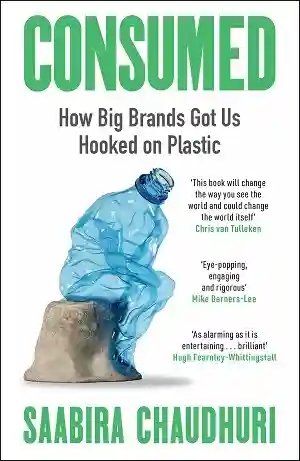
Book Title: Consumed: How Big Brands Got Us Hooked on Plastic
Author: Saabira Chaudhuri
Publisher: Blink Publishing
Number of Pages: 368
ISBN: 978-1785129353
Date Published: Jun 5, 2025
Price: INR 427
Book Review
There’s something disarming about the way “Consumed: How Big Brands Got Us Hooked on Plastic” by Saabira Chaudhuri invites us in—not with alarmist rhetoric, but with calm, clear-eyed storytelling. A seasoned journalist, Saabira Chaudhuri brings her investigative acumen to bear on one of the most pressing issues of our time: the plastic crisis. Yet, instead of pointing fingers, she gently peels back layers of history, economics, and human behaviour to reveal how we arrived at a world where disposability is the default.
Take the humble sachet, for example—those tiny packets of shampoo or detergent that seem so trivial, yet are sold in the billions. In Saabira Chaudhuri’s hands, it becomes a symbol of a larger paradox: innovations designed to uplift millions can also unleash environmental catastrophes. Her deep dive into the rise of the sachet is both fascinating and devastating, tracing how its spread in developing countries made consumer goods more accessible—while leaving behind a trail of non-biodegradable waste no one knows how to manage.
What’s especially compelling is the balance Saabira Chaudhuri strikes. She doesn’t demonize corporations outright, nor does she absolve them. Instead, she presents a mosaic of voices—industry insiders, environmental advocates, ordinary citizens—each contributing a piece to the story. Her interviews illuminate the many contradictions that define our relationship with plastic: its utility versus its permanence, its convenience versus its cost. Nowhere is this clearer than in the chapters on diapers and deceptive recycling campaigns, where she exposes how industries delay change through distraction and denial.
Check out our Latest Book Reviews
But “Consumed” is not just a book about plastic. It’s about the systems that shape our choices and the illusions we cling to about progress and sustainability. It challenges readers to reexamine the everyday—from what we buy to what we throw away. With quiet power, Saabira Chaudhuri makes a case for urgent reckoning, not through blame, but through clarity. The result is not just a compelling read—it’s a nudge toward a different way of seeing the world.
Books are love!
Get a copy now!