


Book Title: From Frontier to the Heartland: A Century of Sangh Parivar In The Northeast
Author(s): Rouhin Deb and Nabaarun Barooah
Publisher: Rupa Publications India
Number of Pages: 312
ISBN: 978-9370034952
Date Published: Jul. 15, 2025
Price: INR 594
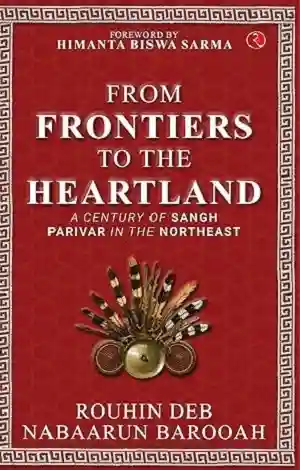
Book Review
“From Frontier to the Heartland: A Century of Sangh Parivar In The Northeast” is a bold and extensively researched account that sheds new light on the century-long engagement of the Sangh Parivar in India’s Northeast. Rouhin Deb and Nabaarun Barooah take readers on an illuminating journey through decades of cultural resistance, socio-political evolution, and organizational perseverance in one of India’s most complex and diverse regions. From the dark days of colonial marginalization to modern challenges of insurgency and identity, the authors position the Sangh Parivar not as an outsider imposing ideology, but as a network gradually embedding itself within indigenous contexts through seva (service) and cultural assimilation.
The book excels in confronting dominant academic narratives with grounded counterpoints based on interviews, oral histories, and anecdotal insights from pracharaks and karyakartas. It reveals how the Sangh’s affiliates adapted to the unique religious and linguistic landscape of the Northeast—not by enforcing a monolithic vision of Hinduism but by embracing and safeguarding native traditions like Donyi-Polo, Sanamahism, and Seng Khasi. Particularly compelling is the portrayal of RSS workers who, despite facing violence and deep-seated suspicion, returned in times of crisis (like the 2020 COVID-19 lockdown) to provide humanitarian relief to the very communities that had previously opposed them.
Authors Deb and Barooah go further by detailing the geopolitical and religious pressures in the region—from British policies like the Inner Line Permit to widespread Christian proselytization and Muslim immigration—which created an ideological battleground. In this context, the Sangh’s long-term strategy of grassroots engagement, education, and cultural revival appears less like a political incursion and more like an organic movement for civilizational preservation. The narrative is both sympathetic and critical, offering a fresh lens through which to view the Northeast’s integration into the Indian political fold.
Check out our Latest Book Reviews
Overall, this work stands out for its unapologetic voice, scholarly diligence, and timely relevance. For anyone seeking to understand not just the Sangh’s role, but the evolving sociopolitical contours of Northeast India, this book is essential reading. It doesn’t merely inform; it invites deeper debate on identity, nationalism, and the meaning of cultural belonging in a region long misunderstood.
Books are love!
Get a copy now!