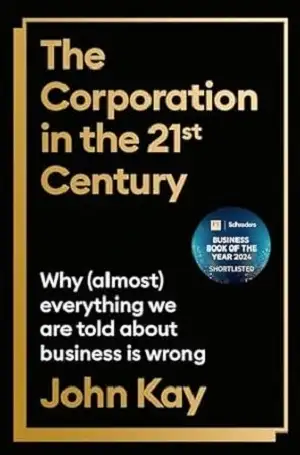
Book Title: The Corporation in the Twenty-First Century: Why (almost) Everything We Are Told about Business is Wrong
Author: John Kay
Publisher: Profile Books
Number of Pages: 448
ISBN: 978-1805221722
Date Published: Aug. 29, 2024
Price: INR 598
Book Review
The book “The Corporation in the Twenty-First Century: Why (almost) Everything We Are Told about Business is Wrong” by John Kay delves into the turbulent realm of contemporary business, drawing comparisons between two key developments in management theory: the unwavering quest of shareholder value and the emergence of the knowledge economy. Kay meticulously analyses how the fall of once-dominant companies like GE and Deutsche Bank illustrates the dangers of putting short-term earnings ahead of long-term development. His main point is very clear: even though the idea of shareholder value has become less popular, it still retains a lot of clout in boardrooms, frequently at the expense of ethics and long-term stability.
Author John Kay expertly illustrates how companies today, like Apple and Meta, thrive not just by amassing financial resources, but by leveraging intellectual capital. He argues that the days of rigid command-and-control management are over; instead, modern businesses flourish through collaboration and inclusivity. This shift has birthed a new type of corporation—what Kay calls the “hollow corporation”—which outsources production and relies on a flexible workforce to adapt quickly to market changes. As he puts it, problem-solving has replaced lean production as the key to competitive advantage, leading to a more empathetic management style that considers social impact alongside profitability.
However, this transformation comes with its own challenges. Despite the innovation these companies bring, there’s a growing public distrust towards big business, largely due to unethical practices and widening inequality. Kay argues that the twenty-first-century corporation is facing a legitimacy crisis, as consumers are increasingly sceptical of the very entities that produce their favourite products. This paradox of loving the goods while loathing the companies that make them forms a compelling narrative thread throughout the book.
Check out our Latest Book Reviews
The author’s suggestion that the terminology we use to talk about business be reevaluated is one of the book’s most noteworthy concepts. According to him, academic paradigms that have been around for a while need to change to reflect how corporate America is evolving. Kay pushes readers to look beyond just financial data by defining “capital” to include personal, social, and natural factors. He contends that profit should not only be seen as a return on financial investment, but also as a reward for providing value to customers.
Though sometimes sharp-tongued, Kay’s insights are deeply thought-provoking and offer a fresh perspective on the future of business. While the book may not delve into emerging trends like artificial intelligence, it sets the stage for a much-needed conversation about the direction of modern capitalism. For anyone interested in understanding the evolving dynamics of business and the importance of ethical leadership, “The Corporation in the Twenty-First Century” is a must-read that promises to inspire and provoke thoughtful discussions.
Books are love!
Get a copy now!