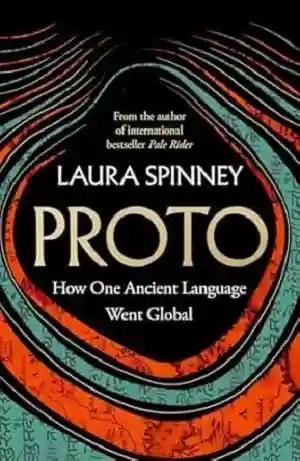
Book Title: Proto: How One Ancient Language Went Global
Author: Laura Spinney
Publisher: William Collins
Number of Pages: 352
ISBN: 978-0008778675
Date Published: Apr. 24, 2025
Price: INR 389
Book Review
In “Proto: How One Ancient Language Went Global“, Laura Spinney sets out to map the tangled roots of the Indo-European language family, but the result is a book that often sacrifices clarity for scope. Her ambition is evident—melding linguistics, genetics, and archaeology into a sweeping narrative—but the execution is uneven. Spinney revisits and extends earlier work by scholars like David W. Anthony, introducing new hypotheses about PIE’s (Proto-Indo-European’s) origins, including a speculative Near Eastern precursor. However, the blend of emerging research and established fact is not always clearly delineated, leaving readers to wonder which findings are widely accepted and which remain contentious.
There’s no denying the energy and readability of Spinney’s prose. She has a knack for storytelling and an eye for arresting detail, bringing ancient migrations, forgotten languages, and obscure artifacts to life. Yet her enthusiasm sometimes overshadows academic rigor. The book breezes through centuries and disciplines, touching on mythology, metallurgy, and trade, but often without sufficient depth. Moments that could have anchored the narrative— such as the linguistic implications of the Mitanni texts or the cultural meaning of the Varna “Thinker”—are mentioned only briefly. When Spinney claims that Sanskrit was “carved into stone” by 1500 BCE, the hyperbole risks misleading readers unfamiliar with the nuances of historical linguistics.
Still, “Proto” is not without its rewards. It offers a valuable reminder of how interdisciplinary collaboration has transformed the study of human history. DNA analysis, for instance, brings new clarity to ancient migration patterns, helping to explain how PIE speakers may have spread across continents. Spinney is at her best when linking these scientific breakthroughs to cultural insights—like how payment in cattle or the crafting of bronze tools might reveal shifts in both language and power. Her willingness to highlight the long-term decline in linguistic diversity is a sobering touch, though it too feels underexplored.
Check out our Latest Book Reviews
As a general introduction to Indo-European languages, “Proto” succeeds in making a complex subject accessible. But for readers looking for a measured, thoroughly sourced account, the book may feel too fast-paced and speculative. Spinney’s work captures the thrill of recent discoveries and the allure of ancient connections, but it occasionally stumbles in its attempt to tie everything together. In a field where precision matters, “Proto” is more a captivating travelogue than a definitive guide.
Books are love!
Get a copy now!