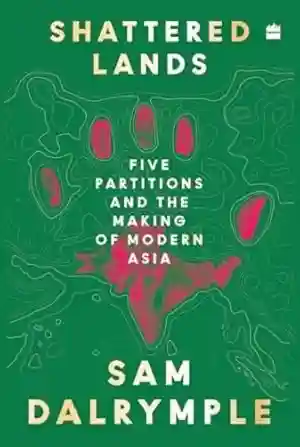
Book Title: Shattered Lands: Five Partitions and the Making of Modern Asia
Author: Sam Dalyrmple
Publisher: Fourth Estate India
Number of Pages: 536
ISBN: 978-9369894628
Date Published: Jun. 19, 2025
Price: INR 519
Book Review
“Shattered Lands: Five Partitions and the Making of Modern Asia” by Sam Dalyrmple is an ambitious and panoramic reassessment of the birth pains of modern South Asia, challenging the simplified national chronicles that often dominate public memory. Sam Dalrymple, a scholar fluent in both the regional languages and the grand sweep of imperial ambition, reconstructs half a century of upheaval—not just Partition, but five major partitions, from Burma’s separation in 1937 to Bangladesh’s violent genesis in 1971. The result is a history that stitches together forgotten memoirs, oral testimony, and lost archives to reveal how a single, sprawling Indian Empire—stretching from the Red Sea to the jungles of Burma and home to a mind-boggling array of ethnic, linguistic, and religious communities—fragmented into a dozen new nations, each with its own tangled narrative of identity, belonging, and exclusion.
Dalrymple’s narrative is unflinching in its portrayal of how borders were redrawn not only by colonial fiat, but by the messy interplay of local elites, revolutionaries, soldiers, and civilians caught in the crossfire. He avoids easy myths of triumph or tragedy, instead underscoring the lingering traces of violence—civil wars in Burma and Sri Lanka, ongoing insurgencies in Kashmir and Baluchistan, the Rohingya crisis—each a living legacy of decisions taken in boardrooms and battlefields, often at tremendous human cost. The book is especially attuned to the voices of those displaced: Dalrymple’s background with Project Dastaan, a refugee reunification initiative, informs his empathetic, intimate storytelling, whether he is revisiting how the Indian rupee once circulated in Dubai or how Yemeni Jews held passports stamped ‘Indian Empire’. The result is a history that feels both panoramic and personal—a rare feat for so sprawling a canvas.
Aesthetically, “Shattered Lands” earns its cinematic comparisons, with a vivid, even novelistic prose style reminiscent of his father William Dalrymple’s work, but with a distinctly original focus and a contemporary, polyphonic sensitivity. Dalrymple junior artfully splices together high politics and ground-level realities, archival gold and family lore—like diaries that surfaced on Instagram, or the stubborn silences in the Gulf archives, where the imperial past has often been erased by modern nationalism[5]. The book’s real achievement, though, is not just in the breadth of its research (spanning English, Hindi, Urdu, Bengali, Punjabi, Konyak, Arabic, and Burmese sources), but in how it reframes the making of modern Asia as a collective, continental story rather than a series of parochial national myths.
Check out our Latest Book Reviews
Yet, for all its ambition, the book’s attempts to balance depth and breadth can sometimes leave the reader wanting more—the sheer scale means individual stories are occasionally overwhelmed by the broader political machinery, and Dalrymple, for all his empathy, sometimes underplays the agency of local actors in favor of the more visible scripts of imperial and post-imperial machinations. Still, in a field crowded with reductive narratives, “Shattered Lands” stands out as a vital antidote, a reminder that the aftershocks of empire and the making of nation-states are not merely commemorative, but ongoing, unfolding process—a challenge, not a closure. It is, in short, the kind of history we need more of: honest, complex, humane, and devastatingly relevant.
Books are love!
Get a copy now!