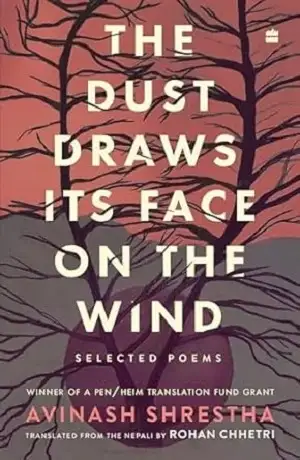
Book Title: The Dust Draws Its Face on the Wind: Selected Poems
Author: Avinash Shrestha
Translator: Rohan Chhetri
Publisher: Harper Perennial India
Number of Pages: 172
ISBN: 978-9362133564
Date Published: Aug. 27, 2024
Price: INR 309
Book Review
“The Dust Draws Its Face on the Wind: Selected Poems” introduces English-speaking audiences to the evocative world of contemporary Nepali poetry through the works of Avinash Shrestha, translated by Rohan Chhetri. This collection is notable for its unique fusion of Nepali vernacular with high diction rooted in Sanskrit, along with elements of Hindu liturgy and Vedic cosmology. Shrestha’s poetry, characterized by its surrealist and syncretic nature, marries the tender aspects of surrealism with postmodern aesthetics, creating a deeply immersive reading experience.
Shrestha’s poetry often grapples with the ineffable, straddling the boundaries of metaphysics and theology. The poet’s attempts to articulate the inexpressible can occasionally come across as elusive, yet these very attempts highlight his willingness to engage with profound existential questions. His work invites readers to confront the complexity of human experience, even if it means navigating through abstract and challenging concepts.
Rohan Chhetri’s translation efforts are both ambitious and insightful. As an award-winning poet and translator, Chhetri brings a nuanced understanding to this project, making it the first serious book-length translation of contemporary Nepali poetry into English. His collaboration with Shrestha adds a layer of depth, although the inclusion of original Nepali poems alongside their English translations can sometimes distract from the reading experience. Chhetri’s addition of personal epigraphs to the translations adds a unique touch, offering readers additional layers of interpretation.
For example, in the translated poem “Relative”, Rohan intricately explores the interplay between beauty and sorrow, suggesting that what appears beautiful may harbour deeper sadness, and vice versa. It delves into natural imagery and abstract concepts, such as age and illusion, to reflect on the complexities of perception and reality. Rich in evocative language, the poem uses vivid imagery and contrasts to highlight the transient nature of time and the layered experiences of life. Its free verse structure and sparse punctuation create a fluid, contemplative tone, encouraging readers to reflect on the nature of existence and their perceptions. The lack of a fixed metrical structure and rhyme scheme aligns with the poem’s themes of complexity and illusion, making it a timeless exploration of human experience.
Check out our Latest Book Reviews
Overall, “The Dust Draws Its Face on the Wind” is a compelling exploration of beauty, sorrow, and the interplay of perception and reality. Shrestha’s use of rich imagery and complex themes, combined with Chhetri’s thoughtful translation, offers readers an opportunity to delve into a distinctive poetic tradition. While the work may pose challenges due to its abstract nature and the structural choices in the translation, it remains a significant contribution to the global literary landscape.
Books are love!
Get a copy now!