
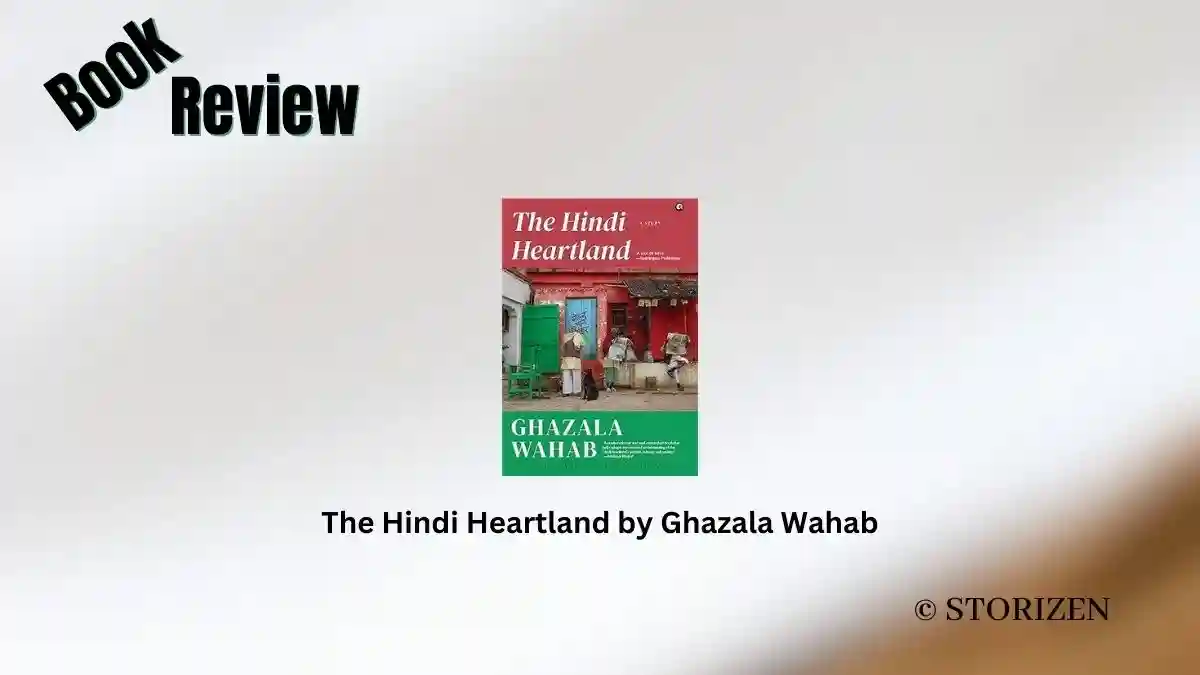
Book Title: The Hindi Heartland: A Study
Author: Ghazala Wahab
Publisher: Aleph Book Company
Number of Pages: 528
ISBN: 978-9395853026
Date Published: Jun. 29, 2025
Price: INR 959

Book Review
Ghazala Wahab’s “The Hindi Heartland: A Study” is a rare and necessary intervention into India’s sociopolitical discourse. Structured as both a contemporary study and a historical excavation, the book reclaims the northern plains of India from the popular narrative of stagnation and communalism. Wahab challenges readers to move beyond stereotypes of “backwardness” by showing the heartland not as a monolith but as a richly layered and evolving region. Her work is an invitation to understand the present not as a rupture from the past, but as its inevitable consequence—shaped by geography, fractured by politics, and haunted by selective memory.
At its core, this is a political book with a historian’s rigor. Wahab draws a compelling arc from ancient mahajanapadas to present-day Uttar Pradesh and Bihar, tracking how geography and empire-building laid the groundwork for contemporary India. Her discussion of language politics, particularly the deliberate creation of “Hindi” as a homogenizing force, is especially astute. By unpacking the origins of linguistic identity and religious nationalism, Wahab exposes the power structures that continue to manipulate regional aspirations. The book’s introduction, detailing the Kanwar Yatra’s state-supported sectarianism, is emblematic of her wider thesis: identity in the Hindi belt has been forged not only by faith, but by politics masquerading as tradition.
What distinguishes “The Hindi Heartland” is its intersectional approach. Wahab deftly weaves caste, gender, religion, and class into her analysis, refusing to flatten the region into easy binaries. Her storytelling—whether she’s recounting a night in a desert border outpost or describing the eerie forests of Dandakaranya—brings a textured sense of place to the reader. These aren’t diversions; they are essential, showing how even the land—arid, fertile, mineral-rich, or flooded—shapes the people who live on it. Particularly powerful is her critique of post-Independence statecraft, where failed development, caste patronage, and communal politics have stymied the region’s progress.
Check out our Latest Book Reviews
Yet for all its critical insight, Wahab’s tone is ultimately forward-looking. Her call is not for nostalgia but for introspection. By re-centering “The Hindi Heartland” in India’s collective imagination—as a crucible of religion, resistance, and renewal—she reminds us that this region can still shape the nation’s destiny, if it chooses to engage with its own complex history honestly. “The Hindi Heartland” is a bold, urgent, and necessary book—one that challenges its readers not just to understand India differently, but to imagine it more generously.
Books are love!
Get a copy now!