Book Title: The History of Ideas: Equality, Justice and Revolution
Author: David Runciman
Publisher: Profile Books
Number of Pages: 320
ISBN: 978-1800815926
Date Published: Jul. 3, 2025
Price: INR 512
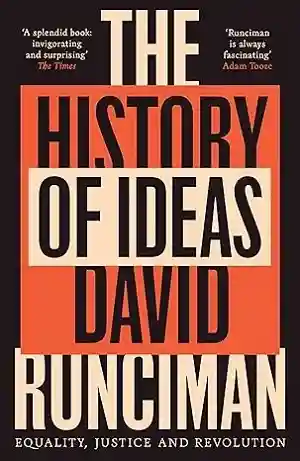
Book Review
“The History of Ideas: Equality, Justice and Revolution” by David Runciman offers an ambitious exploration of foundational political and philosophical ideas through a series of chapters pairing classic texts with contemporary social and political challenges. Runciman’s approach democratizes complex political philosophy, making it accessible by linking thinkers like Rousseau, Douglass, and Rawls to issues like AI, democracy, and inequality today. However, this accessibility sometimes comes at the cost of depth, as the book adopts a somewhat eclectic and fragmented structure that limits deep engagement with its central themes.
Critically, Runciman’s interpretation often emphasizes moderation over radical change, reflecting a skeptical stance towards revolutions and a preference for introspection and gradual transformation. For instance, his reading of Rousseau highlights internal self-awareness rather than systemic upheaval, while he views Frederick Douglass’s activism as evolving into political collaboration. This cautious tone extends to his critique of contemporary technological and political trends, particularly Silicon Valley’s influence, which he aligns with a looming risk to social order. Yet, some chapters—such as those on Rosa Luxemburg or Carl Schmitt—feel disjointed or outside the author’s expertise, creating unevenness and occasional historical inaccuracies that detract from the book’s intellectual rigor.
Check out our Latest Book Reviews
Overall, “The History of Ideas” shines in its ability to spark thoughtful reflection on enduring political concepts and their relevance, but it struggles to fully unify its diverse material into a cohesive analysis of equality, justice, and revolution. Its strength lies in delivering provocative insights with clarity and charm, but readers seeking a rigorous, structured deep dive into these core themes might find the narrative’s breadth and selective focus a limitation. Despite this, the work remains a valuable introduction that challenges readers to reconsider how revolutionary ideas and political justice shape the modern world.
Books are love!
Get a copy now!