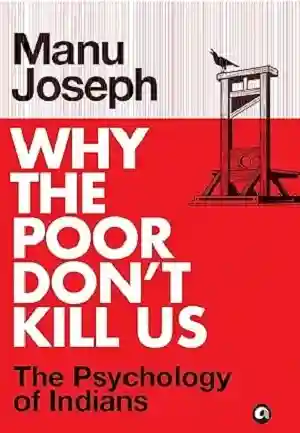
Book Title: Why The Poor Don’t Kill Us: The Psychology of Indians
Author: Manu Joseph
Publisher: Aleph Book Company
Number of Pages: 280
ISBN: 978-9365234572
Date Published: Aug. 5, 2025
Price: INR 465
Book Review
“Why The Poor Don’t Kill Us: The Psychology of Indians” by Manu Joseph is a compelling book that explores a paradox at the heart of Indian society: despite living under some of the harshest social and economic inequalities, India’s poor rarely rise in violent rebellion. Instead, the author shows how centuries of cultural habits, religious beliefs, and deep-rooted social structures have trained people to accept suffering and see it as part of life. The result is a kind of quiet endurance—one that prevents widespread revolt but often turns frustration inward. The poor, far from organizing against the wealthy, compete among themselves for scarce resources. The state, too, plays a role in managing this tension by offering outlets like protests or legal protections that maintain control without truly addressing the root issues. Meanwhile, symbols of extreme wealth—like Ambani’s mansion—stand not as targets of anger, but oddly enough, as distant dreams of what might be possible, reinforcing the illusion of opportunity within an unequal system.
The book also dives deep into how education is sold as a ladder out of poverty, while in reality, it often reinforces class boundaries. Aspiring students from disadvantaged backgrounds find themselves chasing degrees and exam scores that lead to limited mobility, mostly into clerical or academic roles. The system, shaped by colonial legacies and modern elitism, favours those already positioned to succeed. Yet it also co-opts voices of dissent—turning bright, struggling students into symbols of political resistance while offering them few real alternatives. Tragic stories like that of Rohith Vemula are highlighted to show how the system praises success stories on the surface but leaves many others behind, unheard and unseen.
Check out our Latest Book Reviews
Throughout the book, the author contrasts India’s chaotic, vibrant public life with the orderliness of the West. Indian cities, full of noise, unpredictability, and disorder, may seem dysfunctional but are seen by many as authentic. Even structured spaces like the Delhi Metro are outliers, symbols of what India could be, rather than what it is. This disordered freedom is interpreted not just as a failure of governance but as a form of resistance—where Indians resist the cold efficiency of Western systems, associating chaos with spontaneity and humanity. In this space between chaos and control, hope and resignation, India’s unique social character takes shape—layered, complex, and deeply tied to a historical system that both sustains and suppresses its people.
Books are love!
Get a copy now!